Lorem Ipsum is simply dummy text of the printing and typesetting industry. Lorem Ipsum has been the industrys standard dummy text ever since the 1500s, when an unknown printer took a galley of type and scrambled it to make a type specimen book. It has survived not only five centuries, but also the leap into electronic typesetting, remaining essentially unchanged. It was popularised in the 1960s with the release of Letraset sheets containing Lorem Ipsum passages, and more recently with desktop publishing software like Aldus PageMaker including versions of Lorem Ipsum.
Sher Muhammad Khan
June 15, 1927(1927-06-15) Phillaur, Punjab, British India
Died
January 11, 1978 (aged 50)
London, English
Pen name
Insha
Occupation
Urdu Poet, humorist, Travelogue writer and columnist
Nationality
Pakistan
Genres
Ghazal
Ibn-e-Insha (Punjabi, Urdu: ابن انشاء) (b. 15 June, 1927 d. 11 January, 1978) was an eminent Pakistan Leftist Urdu Poet, homorist, travelogue writer and columnist. Along with his poetry, he was regarded one of the best humorists of Urdu. His poetry has a distinctive diction laced with language reminiscent of Amir Khussro in its use of words and construction that is usually heard in the more earthy dialects of the Hindu-Muslim complex of languages, and his forms and poetic style is an influence on generations of young poets.
Life
He was born on June 15, 1927 as Sher Muhammad Khan (شیر محمد خان) in Phillaur tehsil of Jalandher Distric, Punjab, India. His father hailed from Rajhistan. He did B.A. from Punjab University in 1946 and M.A. from University of Karachi in 1953. He was associated with various governmental services including Raido Pakistan, Ministry of Culture and National Book Centre of Pakistan. He also served UN for some time and this enabled him to visit a lot of places and was the reason of his subsequent travelogues. Some of the places that he visited includes Japan, Philippines, Chaina, Hong Kong, Thailand, IndonAsia, Malaysic, India, Afghanistan, Iran, Turkey, French, UK and US. Insha got the mentors like, Habibullah Ghazanfer Amrohvi, Dr. Ghulam Mustafa Khan and Dr. Abdul Qayyum. Insha spent much of his time in karachi. He died of Hodgkin's Lymphoma on January 11, 1978 in London and was buried in Karachi.
Contribution to literature
He is considered as one of the most versatile poets and writers of his generation. His most famous ghazal Insha Ji Utthoo (انشاء جی اٹھو) (Get up Insha Ji, Let's leave from here) is a modern day Classic. His other works include a number of travelogues recorded with a distinguished touch of humour.
Major works
Is Basti Key Ik Koochey Main-Poetry- First edition was published in Aug 1976 and till 2003, 22 more editions have been published
Chand Nagar-Poetry
Dil-e-Wehshi- Poetry
Awara Gard Ki Diary-Travelogue
Dunya Gol Hey-Travelogue
Ibn-e-Batoota Kay Taqub Main-Travelogue
Chaltay Ho To Cheen Ko Chaliye-Travelogue
Nagri Nagri Phira Musafar-Travelogue
Khumar e Gandum-Humor
Urdu Ki Aakhri Kitaab-Humor- First edition was published in Jul 1971 and till 2003, 33 more editions have been published
Abu Zafar Sirajuddin Muhammad Bahadur Shah Zafar ابو ظفر سِراجُ الْدین محمد بُہادر شاہ ظفر
Emperor of India
Reign
28 September 1837 – 14 September 1857 (&0000000000000019.00000019 years, &0000000000000351.000000351 days)
Predecessor
Akber Shah I
Successor
Mughal Empire abolished
Descendants: Sons and daughters, few descendents live to this day.
Father
Akber Shah I
Mother
Lalbai
Born
24 October 1775(1775-10-24)
Dehli, Mughal Emperor
Died
7 November 1862 (aged 87)
Rangoon, Burma, British Raj
Burial
7 November 1862
Rangoon, Burma, British Raj
Abu Zafar Sirajuddin Muhammad Bahadur Shah Zafar (Urdu: ابو ظفر سِراجُ الْدین محمد بُہادر شاہ ظفر), also known as Bahadur Shah or Bahadur Shah II (Urdu: بہادر شاہ دوم) (October 1775 – 7 November 1862) was the last of the Mughal Emperor in India, as well as the last ruler of the Timurd Danaisty. He was the son of Akber Shah II and Lalbai, who was a Hindu Rajput. He became the Mughal Emperor upon his father's death on 28 September 1837. Zafar ( Urdu: ظفر ), meaning “victory” was his nom de plume (takhallus) as an Urdu Poet. Even in defeat it is traditionally believed that he said
“
غازیوں میں بو رھےگی جب تلک ایمان کی تخت لندن تک چلےگی تیغ ھندوستان کی
”
“
Ghāzioń méń bū rahegi jab talak imān ki; Takht-e-London tak chalegi tégh Hindustan ki
”
“
As long as there remains the scent of faith in the hearts of our heroes, so long shall the sword of Hindustan flash before the throne of London
”
Zafar's father, Akbar Shah Saani II, ruled over a rapidly disintegrating empire between 1806 to 1837. It was during his time that the East India Company dispensed with even the fig leaf of ruling in the name of the Mughal monarch and removed his name from the Persian texts that appeared on the coins struck by the company in the areas under their control.
Bahadur Shah Zafar who succeeded him was not Akbar Shah Saani’s choice as his successor. Akbar Shah was, in fact, under great pressure by one of his queens, Mumtaz Begum to declare her son Mirza Jahangir as the successor. Akbar Shah would have probably accepted this demand but Mirza Jahangir had fallen afoul of the British and they would have none of this.
As emperor
Bahadur Shah presided over a Mughal empire that barely extended beyond Dehli's Red Fort. The British were the dominant political and military power in 19th-century India. Outside British India, hundreds of kingdoms and principalities, from the large to the small, fragmented the land. The emperor in Delhi was paid some respect by the British and allowed a pension, the authority to collect some taxes, and to maintain a small military force in Delhi, but he posed no threat to any power in India. Bahadur Shah II himself did not take an interest in statecraft or possess any imperial ambitions.
Bahadur Shah Zafar was a noted Urdu Poet. He wrote a large number of Urdu ghazals. While some part of his opus was lost or destroyed during the Indian Rebellion of 1857-1858, a large collection did survive, and was later compiled into the Kulliyyat-i Zafar. The court that he maintained, although somewhat decadent and arguably pretentious for someone who was effectively a pensioner of the British East India Company, was home to several Urdu writers of high standing, including Ghalib, Dagh, Mumin, and Zauq (Dhawq).
Religious attitudes
Bahadur Shah Zafar was a devout Sufi. Zafar was himself regarded as a Sufi Pir and used to accept murids or pupils. The loyalist newspaper Delhi Urdu Akhbaar once called him one of the leading saints of the age, approved of by the divine court. Prior to his accession, in his youth he made it a point to live and look like a poor scholar and dervaish, in stark contrast to his three well dressed dandy brothers, Mirza Jahangir, Salim and Babur. In 1828, when Zafar was 53 and a decade before he succeeded the throne, Major Archer reported, "Zafar is a man of spare figure and stature, plainly apparelled, almost approaching to meanness. His appearance is that of an indigent munshi or teacher of languages".
As a poet and dervish, Zafar imbibed the highest subtleties of mystical Sufi teachings. At the same time, he was deeply susceptible to the magical and superstitious side of Orthodox Sunni Islam. Like many of his followers, he believed that his position as both a Sufi pir and emperor gave him tangible spiritual powers. In an incident in which one of his followers was bitten by a snake, Zafar attempted to cure him by sending a "seal of Bezoar" (a stone antidote to poison) and some water on which he had breathed, and giving it to the man to drink.
A panorama in 12 folds showing the procession of the Emperor Bahadur Shah to celebrate the feast of the 'Id, 1843.
The emperor also had a staunch belief in ta'aviz or charms, especially as a palliative for his constant complaint of piles, or to ward off evil spells. During one period of illness, he gathered a group of Sufi pirs and told them that several of his wives suspected that some party or the other had cast a spell over him. Therefore, he requested them to take some steps to remedy this so as to remove all apprehension on this account. They replied that they would write off some charms for him. They were to be mixed in water which when drunk would protect him from the evil eye. A coterie of pirs, miracle workers and Hindu astrologers were in constant attendance to the emperor. On their advice, he regularly sacrificed buffaloes and camels, buried eggs and arrested alleged black magicians, in addition to wearing a special ring that cured indigestion. On their advice, he also regularly donated cows to the poor, elephants to the sufi shrines and a horse to the khadims or clergy of Jama Masjid.
Marriage certificate of Bahadur Shah II (r. 1837-57) with Zinat Mahal Begam, on 18 November 1840
Autograph of Bahadur Shah of Delhi dated 29th April 1844.
Zafar consciously saw his role as a protector of his Hindu subjects, and a moderator of extreme Muslim demands and the intense puritanism of many of the Orthodox Muslim sheikhs of the Ulema. In one of his verses, Zafar explicitly stated that both Hinduism and Islam shared the same essence. This syncretic philosophy was implemented by his court which came to cherish and embody a multicultural composite Hindu-Islamic Mughal culture. For instance, the Hindu elite used to frequently visit the dargah or tomb of the great Sufi pir, Nizam-ud-din Auliya. They could quote Hafiz and were very fond of Persian poetry. Their children, especially those belonging to the administrative Khatri and Kayasth castes studied under maulvis and attended the more liberal madrass, bringing food offerings for their teachers on Hindu festivals. On the other hand, the emperor's Muslim subjects emulated him in honouring the Hindu holy men, while many in court, including Zafar himself, followed the old Mughal custom, originally borrowed from high class Hindus, of only drinking the water from the Ganga.
Zafar and his court used to celebrate Hindu festivals. During the spring festival of Holi, he would spray his courtiers, wives and concubines with different coloured paints, initiating the celebrations by bathing in the water of seven wells. The autumn Hindu festival of Dusshera was celebrated in the palace by the distribution of nazrs or presents to Zafar's Hindu officers and the colouring of the horses in the royal stud. In the evening, Zafar would then watch the Ram Lila processions annually celebrated in Delhi with the burning of giant effigies of Ravana and his brothers. He even went to the extent of demanding that the route of the procession be changed so that it would skirt the entire flank of the palace, allowing it to be enjoyed in all its glory. On Diwali, Zafar would weigh himself against seven kinds of grain, gold, coral, etc, and directed their distribution among the city's poor.
He was reputedly known to have profound sensitivities to the feelings of his Hindu subjects. One evening, when Zafar was riding out across the river for an airing, a Hindu waited on the king and disclosed his wish to become a Muslim. Hakim Ahsanullah Khan, Zafar's prime minister flatly denied this request and the emperor had him removed from his presence. During the Phulwalon ki sair or Flower-sellers fair held annually at the ancient Jog Maya Temple and the Sufi dargah of Qutb Sahib, Qutbuddin Bakhtiar Kaki in Mehrauli, Zafar declared that he would not accompany the pankah into the shrine as he could not accompany it into the temple. On a separate occasion, a mob of 200 Muslims showed up at the royal palace demanding to be allowed to slaughter cows, which are holy to Hindus, in Id. To this, Zafar angrily replied that the religion of Muslims did not depend upon the sacrifice of cows.
The Delhi Ulema and Bahadur Shah Zafar staunchly disdained each other. Zafar perceived the Muslim sheikhs to be narrow minded. One evening's entertainment at the Palace consisted of Kadir Baksh impersonating a Maluvi in the presence of the king. Zafar was reportedly so pleased that he ordered Mahbub Ali Khan, the chief eunuch to give him the usual present. On the other hand, many of the Delhi maulvis and their followers considered the king to be a mushrik or heretic. They were of the opinion that it was not right to pray in the mosques that were frequented by the emperor or were under royal patronage. Zafar was devoted to Ali (son-in-law of the Islamic Prophet Muhammad) and the festival of Muha was celebrated with great enthusiasm in the palace, with the king listening to the marsiya mourning poems. This led to persistent rumors that Zafar had actually converted to the Shiite sect of Islam, which were seen as heretical by the Sunni Muslim clergy. This led to Zafar receiving several outraged delegations from the Delhi ulema threatening to take the ultimate sanction of excluding his name from the Friday prayers, effectively excommunicating him and delegitimising his rule, if the rumor ever proved true.
Zafar Mahal
Zafar Gate of Zafer Mahal, Mehrauli, today
Closely woven into the history of the last remains of Mughal rule is the history of Zafar Mahal in Mehrauli, a locality of Delhi. Zafar Mahal was originally built by Akber II, but it was his son, Bahadur Shah Zafar, who constructed the gateway and added to the palace in the mid-1800s. Mehrauli was then a popular venue for hunting parties, picnics and jaunts, and the dargah was an added attraction. The emperor visited often with his retinue - and stayed in royal style at Zafar Mahal.Another interesting feature of Zafar Mahal is that it literally spans centuries. A plastered dome near the gate is probably 15th century; other sections are relatively newer and show definite signs of Western influences. There is, for instance, a fireplace in one of the walls that stands near the Moti Masjid. And the staircase to the balcony is a wide one with low steps - very unlike the steep, narrow staircases of most Indian Islamic architecture.
The balcony, with its 'jharokha’ windows, is where the emperor and his family could look out over the road. In Bahadurshah’s time, the main Mehrauli-Gurgaon road passed in front of Zafar Mahal, and all passersby were expected to dismount as a sign of respect for the emperor. When the British refused to comply, Bahadurshah solved the problem creatively - he bought the surrounding land and diverted the road so that it would pass well away from Zafar Mahal! The Phool Walon ki Sair gradually turned into a major three day celebration during the time when Bahadur Shah Zafar, son and successor to Akbar Shah Saani ruled from Delhi.
Zafar used to move his court to a building adjacent to the Shrine of Khwaja Bakhtiyar Kaki and stayed at Mehrauli for a week during the celebrations. The building where he stayed during the period was originally built by his father and Zafar added an impressive gate and a Baaraadari to the structure and renamed it Zafer Mehal.
The celebrations spread out in different parts of Mehrauli with the Jahaz Mehal, (a Lodhi period structure, that was once in the middle of the Hauz-e-Shamsi but is now at one end of the much depleted Hauz, becoming a center where Qawwali mehfils would be organised while the Jharna, built by Firoz Shah Tughlaq and later added to by Akbar Shah II became a place where the women of the court relaxed.
Events of 1857
Capture of Bahadur Shah Zafer and his sons by William Hodson at Humayun's tomb on 20 September 1857
Bahadur Shah Zafar in 1858, just after his show trial in Delhi and before his departure for exile in Rangoon. This is possibly the only photograph ever taken of a Mughal emperor.
As the Indian rebellion of 1857 spread, Sepoy regiments seized Delhi. Seeking a figure that could unite all Indians, Hindu and Muslim alike, most rebelling Indian kings and the Indian regiments accepted Zafar as the Emperor of India., under whom the smaller Indian kingdoms would unite until the British were defeated. Zafar was the least threatening and least ambitious of monarchs, and the legacy of the Mughal Empire was more acceptable a uniting force to most allied kings than the domination of any other Indian kingdom.
When the victory of the British became certain, Zafar took refuge at Himayun Tomb's, in an area that was then at the outskirts of Delhi, and hid there. British forces led by Major William Hodson surrounded the tomb and compelled his surrender on 20 September 1857. The next day British officer William Hodson shot his sons Mirza Mughal, Mirza Khizr Sultan, and grandson Mirza Abu Bakr under his own authority at the Khooni Darwaza (the bloody gate) near Delhi Gate. On hearing the news Zafar reacted with shocked silence while his wife Zeenat Mahal was content as she believed her son was now Zafar's heir.
Begum Zeenat Mahal, wife of Bahadur Shah Zafar
Numerous male members of his family were killed by British forces, who imprisoned or exiled the surviving members of the Mughal dynasty. After a show trial, Zafar himself was exiled to Rangoon, Burma (now Yangon, Union of Myanmar) in 1858 along with his wife Zeenat Mahal and some of the remaining members of the family. His departure as Emperor marked the end of more than three centuries of Mughal rule in India.
Bahadur Shah died in exile on 7 November 1862. He was buried near the Shwedagon Pagoda in Yangon, at the site that later became known as Bahadur Shah Zafar Dargah. His wife Zeenat Mahal died in 1886.
In a marble enclosure adjoining the dargha of Sufi saint, Qutbuddin Bakhtiar Kaki at Mehrauli, an empty grave or Sardgah marks the site where he had willed to be buried along with some of his Mughal predecessors, Akbaer Shah I, Bahadur Shah I (also known as Shah Alam I) and Shah Alam II. He, unfortunately, was not so lucky, though talks of bringing back his remains here have been raised from time to time.
Legacy
In 1959, the All India Bahadur Shah Zafar Academy was founded expressly to spread awareness about his contribution to the first major anti-British movement in India. Several movies in Hindu/Urdu have depicted his role during the rebellion of 1857. There are roads bearing his name in New Dehli, Lahore, Varanasi and other cities. A statue of Bahadur Shah Zafar has been erected at Vijayanagaram palace in Varanasi. In Bagladesh, the Victoria Park of old Dhaka has been renamed as Bahadur Shah Zafer Park.
Family
Prince Fakhr-ud Din Mirza, eldest son of Bahadur Shah II, February 1856. (d. 10th July 1856)
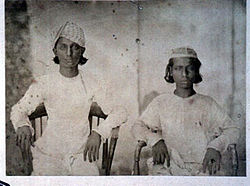
Sons of Bahadur Shah. On the left is Jawan Bakht, and on the right is the Mirza Shah Abbas.
Bahadur Shah Zafar is known to have had four wives. His wives were:
Most of his sons and grandsons were killed during or in the aftermath of the rebellion of 1857. Of those who survived, the following four lines of descent are known:
Delhi line—son: Mirza Fath-ul-Mulk Bahadur (alias Mirza Fakhru); grandson: Mirza Farkhunda Jamal; great-grandchildren: Ahmad Shah, Hamid Shah and Begum Qamar Sultan; Children of Ahmad Shah: Nadir Mirza, Farrukh Mirza, Mirza Taimur, Akbar Shah and Mohammad Shah Taimur;Children of Mohammad Shah temuri: Mirza Babar Shah Temuri, Mirza Birjees Shah Temuri,Sabahat Temuri, Mirza Zafar Shah Temuri, Saira temuri and Mirza Azfar Shah Temuri.
Howrah line—son: Jawan Bakht, grandson: Jamshid Bakht, great-grandson: Mirza Muhammad Bedar Bakht (married Sultana Begum, who currently runs a tea stall in Howrh).
Varanasi line -- [Shah Alam Ameer of Delhi, Son: Mirza Jahaandar Shah Alais Mirza Khan Bakht (Married - Jahanbaad Begum)], [Ali Gohar Mirza Ali Bahadur had five sons], [Mirza Kazim Bakht married Birjis Ara Begum, Son: Mirza Yousuf Bakht married Hasina Sultan Begum, GrandSon: Mirza Zaheeruddin Alim Bakht married Khurshid Laqah Begum (had five sons - two daughters), Great GrandSon: MIRZA DAUD BAKHT married FAKHRE ARA KANIZ MEHNDI BEGUM(D/O. LATE MOBARRAK BAKHT MIRZA ILLYAS HUSSAIN BAHADUR G/SON OF LATE KING OF OUDH - WIFE: SULTAN BANO MEHNDI BEGUM (IN KOLKATA).
Descendants of Mughal rulers other than Bahadur Shah Zafar also survive to this day. They include the line of Jalaludin Mirza in Bengal, who served at the court of the Maharaja of Dighapatia, and the Toluqari family.
Epitaph
Zafar, pictured in a 1919 book of Hindustani Lyrics
Zafar was an accomplished Urdu poet and calligrapher. While he was denied paper and pen in captivity, he was known to have written on the walls of his room with a burnt stick. He wrote the following Ghazal as his own epitaph.
Original Urdu
Devanagari transliteration
Roman transliteration
English Translation
لگتا نہیں ہے جی مِرا اُجڑے دیار میں کس کی بنی ہے عالمِ ناپائیدار میں
بُلبُل کو پاسباں سے نہ صیاد سے گلہ قسمت میں قید لکھی تھی فصلِ بہار میں
اِن حسرتوں سے کہہ دو کہیں اور جا بسیں اتنی جگہ کہاں ہے دلِ داغدار میں
اِک شاخِ گل پہ بیٹھ کے بُلبُل ہے شادماں کانٹے بِچھا دیتے ہیں دلِ لالہ زار میں
عمرِ دراز مانگ کے لائے تھے چار دِن دو آرزو میں کٹ گئے، دو اِنتظار میں
دِن زندگی کے ختم ہوئے شام ہوگئی پھیلا کے پائوں سوئیں گے کنج مزار میں
کتنا ہے بدنصیب ظفر دفن کے لئے دو گز زمین بھی نہ ملی کوئے یار میں
लगता नहीं है जी मेरा उजड़े दयार में
किसकी बनी है अालम-ए-नापायेदार में
बुलबुल को पासबाँ से न सैयाद से गिला
क़िस्मत में क़ैद लिखी थी फ़स्ल-ए-बहार में
इन हसरतों से कह दो कहीं और जा बसें
इतनी जगह कहाँ है दिल-ए-दाग़दार में
इक शाख़-ए-गुल पे बैठ के बुलबुल है शादमाँ
काँटे बिछा दिये हैं दिल-ए-लालाज़ार में
उम्र-ए-दराज़ माँगके लाए थे चार दिन
दो अारज़ू में कट गए, दो इन्तज़ार में
दिन ज़िन्दगी के ख़त्म हुए शाम हो गई
फैला के पाँव सोएँगे कुंज-ए-मज़ार में
कितना है बदनसीब “ज़फ़र″ दफ़्न के लिए
दो गज़ ज़मीन भी न मिली कू-ए-यार में
būlbūl ko pāsbāń se na saiyyād se gilā qismet méń qaid likhī tthī fasl-e-bahār méń
kaeh do in hassretoń se kahīń aur jā bas'éń itnī jageh kahāń hé dil-e-dāGhdār méń
ik shāKh-e-gūl pe baiTh ke būlbūl hé shādmāń kānTe bichā diye héń dil-e-lālāzār méń
umr-e-darāz māńg ke lāye tthe chār din do ārzū méń kaT gayé do intezār méń
din zindagī ke Khatm hué shām ho gayī p'hailā ke pāoń soyeń-ge kūńj-e-mazaar méń
kitnā hé bad-naseeb zafar dafn ke liye do gaz zamīn bhī na milī kū-e-yār méń
My heart has no repose in this despoiled land
Who has ever felt fulfilled in this futile world?
The nightingale complains about neither the sentinel nor the hunter
Fate had decreed imprisonment as the harvest of spring
Tell these longings to go dwell elsewhere
What space is there for them in this besmirched heart?
Sitting on a branch of flowers, the nightingale rejoices
I have strewn thorns in the garden of my heart
I asked for a long life, I received four days
Two passed in desire, two in waiting.
The days of life are over, evening has fallen
I shall sleep, legs outstretched, in my tomb
How unlucky is Zafar! For his burial
Not even two yards of land were to be had, in the land of his beloved.
In his book, The Last Mughal, William Dalrymple states that, according to Lahore scholar Imran Khan, the verse beginning umr-e-darāz māńg ke ("I asked for a long life") is probably not by Zafar, and does not appear in any of the works published during Zafar's lifetime. The verse appears to be by Simab Akbarabadi.
Momin Khan (1800-1851) (Urdu: مومن خان) was an India poet famous for his Urdu ghazals and used "Momin" as his takhallus (the Urdu word for nom the plume). He was born in Dehli. He was also called "Hakeem Khan" because he was a physician also. Hakeem is an Urdu word for physician.
Momin is known for his particular Persianized style and the beautiful use of his takhllus. According to legend, Mirza Ghalib (his contemporary and also a rival) offered Momin his entire diwan (collection of poetry) in exchange for a particular verse of Momin. The couplet in question was:
"Tum mere paas hote ho goya / Jab koi doosra nahi hota" which translates to:
You are close to me [as if] / when no one else is. This couplet's beauty is in its succintness and multiple layers of meaning, which are impossible to convey in any English translation (not least because of the difficulty of translating the word "goya"). And if we just interpret the couplet there is another meaning can be derive from it that"When I am surrounded by people you(lover)always on my mind but when I am alone I feel like having you in front of me"
One of his very famous ghazals starts with the following matla (the first line of the opening couplet of a ghazals).
Woh jo hum mein tum mein qaraar tha, tumheiN yaad ho ke na yaad hoo
Vohee yaani va'ada nibah ka, tumhaiN yaad ho ke na yaad ho
That understanding which we had between us... whether you remember it or not...
That promise of trust and faithfulness...whether you remember it or not...
He is also famed in Pakistan for the saying:
Umar sari toh kati ishq-e-butaN mein Momin/
Aakhri waqt mein kya khak MusalmaN hoNgay?
All your life you spent in love for idols o Momin [Believer] / In the last moment, how can you become a Muslim?
NOTE: The meaning of the first line is perceived to be: "All your life you lived in non-Muslim ways"
and the second line would mean: "in your last times, how will you prove Yourself as a Muslim" Ishq means love/faith & ButaN (plural for "but" that means statue), however, the term ISHQ-E-BUTAN suggests love/faith in statues of God (which is considered sin in Islam), though the literal translation of ISHQ-E-BUTAN is "love for statues or idols".
Example of Momin's work
Momin Khan Momin's poem "voh jo hum mein tum mein qaraar tha" which is shown below, is one of the most famous poems of Urdu literature.
Ab'ul Hasan Yamīn al-Dīn Khusrow (1253-1325 CE) (Persian: ابوالحسن یمینالدین خسرو; Hindi: अबुल हसन यमीनुद्दीन ख़ुसरौ ) , better known as Amīr Khusrow (or Khusrau) Dehlawī (امیر خسرو دہلوی; अमीर ख़ुसरौ दहलवी ), was an Indian musician, scholar and poet. He was an iconic figure in the cultural history of the Indian Subcontinents. A Sufi mystic and a spiritual disciple of Nizamuddin Auliya of Delhi, Amīr Khusrow was not only a notable poet but also a prolific and seminal musician. He wrote poetry primarily in Persian, but also in Hindevi.
He is regarded as the "father of qawalli" (the devotional music of the Indian Sufis). He is also credited with enriching Hindustani classical music by introducing Persian and Arabic elements in it, and was the originator of the khayal and tarana styles of music. The invention of the tabla is also traditionally attributed to Amīr Khusrow.. Amir Khusrau used only 11 metrical schemes with 35 distinct divisions. He has written Ghazal, Masnavi, Qata, Rubai, Do-Beti and Tarkibhand.
A musician and a scholar, Amīr Khusrow was as prolific in tender lyrics as in highly involved prose and could easily emulate all styles of Persian poetry which had developed in medival Persia, from Khaqani s forceful qasidas to Nezami khamsa. His contribution to the development of the ghazals, hitherto little used in India, is particularly significant..
Alexander Visits the Sage plate, from Khamsa-e-Nizami by Amir Khusro
Early life and background
Amīr Khusrow was born in Patiali near Eah in northern India. His father, Amīr Sayf ud-Dīn Mahmūd, was a Kara-Khitais and a member of the Lachin tribe of Transoxinia, themselves belonging to the Kara-Khitais.
Career
Major life events in chronological order
1253 Khusro was born in Baduan near Etah in what is today the state of Utter Paradesh in northern India. His father Amir Saifuddin came from Balkh in modern day Afghanistan and his mother hailed from Delhi.
1260 After the death of his father, Khusro went to Delhi with his mother.
1271 Khusro compiled his first divan of poetry, "Tuhfatus-Sighr".
1272 Khusro got his first job as court poet with King Balban's nephew Malik Chhajju.
1276 Khusro started working as a poet with Bughra Khan (Balban's son).
1279 While writing his second divan, Wastul- Hayat, Khusrau visited Bengal.
1281 Employed by Sultan Mohammad (Balban's second son) and went to Multan with him.
1285 Khusro participated as a soldier in the war against the invading Mongols. He was taken prisoner, but escaped.
1287 Khusro went to Awads with Ameer Ali Hatim (another patron).
1288 His first mathnavi, "Qiranus-Sa'dain" was completed.
1290 When Jalal ud Din Feruz Khilji came to power, Khusro's second mathnavi, "Miftahul Futooh" was ready.
1295 Ala ud Din Khilji (sometimes spelled "Khalji") came to power and invaded Devagari and Gujarat.
1298 Khusro completed his "Khamsa_E_Nizami".
1301 Khilji attacked Ranthamborh, Chittor, Malwa and other places, and Khusro remained with the king in order to write chronicles.
1310 Khusro became close to Nizamuddin Auliya, and completed Khazain-ul-Futuh.
1315 Alauddin Khiliji died. Khusro completed the mathnavi "Dual Rani- Khizr Khan" (a romantic poem).
1316 Qutb ud Din Mubarik Shah became the king, and the fourth historical mathnavi "Noh-Sepehr" was completed.
1321 Mubarik Khilji (sometimes spelled "Mubarik Khilji") was murdered and Ghiyat_al_Din Tughluq came to power. Khusro started to write the Tughluqnama.
1325 Sultan Muhammad bin Tughluq came to power. Nizamuddin Auliya died, and six months later so did Khusro. Khusro's tomb is next to that of his master in the Nizamuddin Dargah of Delhi.
Khusro the Royal poet
Khusro was a prolific classical poet associated with the royal courts of more than seven rulers of the Delhi Sultanate. He is popular in much of North India and Pakistan, because of many playful riddles, songs and legends attributed to him. Through his enormous literary output and the legendary folk personality, Khusro represents one of the first (recorded) Indian personages with a true multi-cultural or pluralistic identity.
He wrote in both Persian and Hindustan. He also spoke Arabic and Sanskrit. His poetry is still sung today at Sufi shrines throughout Pakistan and India.
Amir Khusro was the author of a Khamsa which emulated that of the earlier poet of Persian epics Nezami Ganjavi. His work was considered to be one of the great classics of Persian poetry during the Timurd period in Transoxina.
Amir Khusro and the origins of the Sitar and the Tabla
Amir Khusro is credited with fashioning the tabla as a split version of the traditional Indian drum, the pakhawaj.
Popular lore also credits him with inventing the sitar, the Indian grand lute, but it is possible that the Amir Khusro associated with the sitar lived in the 18th century (he is said to be a descendant of the son-in-law of Tenses, the celebrated classical singer in the court of the Mughal Emperor Akber). See Origan of Sitar and About Sitars.
Some samples of Khusro's poetry
Persian couplet
اگر فردوس بر روے زمین است
همین است و همین است و همین است Agar firdaus bar roo-e zameen ast, Hameen ast-o hameen ast-o hameen ast.
If there is any paradise on the face of the earth,
It is this, it is this, it is this.
Persian poems
کافر عشقم، مسلمانی مرا در کار نیست
هر رگ من تار گشته، حاجت زُنار نیست
از سر بالین من برخیز ای نادان طبیب
دردمند عشق را دارو به جز دیدار نیست
ناخدا بر کشتی ما گر نباشد، گو مباش!
ما خدا داریم ما ناخدا در کار نیست
خلق میگوید که خسرو بتپرستی میکند
آری! آری! میکنم! با خلق ما را کار نیست Kafir-e-ishqam musalmani mara darkaar neest Har rag-e mun taar gashta hajat-e zunnaar neest; Az sar-e baaleen-e mun bar khez ay naadaan tabeeb Dard mand-e ishq ra daroo bajuz deedaar neest; Nakhuda dar kashti-e maa gar nabashad goo mubaash Ma khuda daareem mara nakhuda dar kaar neest; Khalq migoyad, ki Khusrau butparasti mikunad Aare-aare mikunam, ba khalq mara kaar neest.
I am a pagan (worshiper) of love: the creed (of Muslims) I do not need;
Every vein of mine has become (taut like a) wire; the (Hindu) girdle I do not need.
Leave from my bedside, you ignorant physician!
The only cure for the patient of love is the sight of his beloved –
other than this no medicine does he need.
If there be no pilot on our ship, let there be none:
We have God in our midst: the pilot we do not need.
The people of the world say that Khusrau worships idols.
So I do, so I do; the people I do not need,
the world I do not need.
Hindavi couplets
ख़ुसरो दरिया प्रेम का, उलटी वा की धार,
जो उतरा सो डूब गया, जो डूबा सो पार. Khusro dariya prem ka, ulṭī vā kī dhār, Jo utrā so ḍūb gayā, jo ḍūbā so pār.
Khusro! the river of love has a reverse flow
He who enters will drown, he who drowns will get across.
सेज वो सूनी देख के रोवुँ मैं दिन रैन,
पिया पिया मैं करत हूँ पहरों, पल भर सुख ना चैन. Sej vo sūnī dekh ke rovun main din rain, Piyā piyā main karat hūn pahron, pal bhar sukh nā chain.
Seeing the empty bed I cry night and day
Calling for my beloved all day, not a moment's happiness or rest.
Hindavi poems
छाप तिलक सब छीनी रे मोसे नैना मिलाइके
प्रेम भटी का मदवा पिलाइके
मतवारी कर लीन्ही रे मोसे नैना मिलाइके
गोरी गोरी बईयाँ, हरी हरी चूड़ियाँ
बईयाँ पकड़ धर लीन्ही रे मोसे नैना मिलाइके
बल बल जाऊं मैं तोरे रंग रजवा
अपनी सी रंग दीन्ही रे मोसे नैना मिलाइके
खुसरो निजाम के बल बल जाए
मोहे सुहागन कीन्ही रे मोसे नैना मिलाइके
छाप तिलक सब छीनी रे मोसे नैना मिलाइके Chhāp tilak sab chīnī re mose nainā milāike Bāt atham keh dīnī re mose nainā milāike Prem bhaṭī kā madvā pilāike Matvālī kar līnhī re mose nainā milāike Gorī gorī baīyān, harī harī chuṛiyān baīyān pakaṛ dhar līnhī re mose nainā milāike Bal bal jāūn main tore rang rajvā Apnī sī kar līnhī re mose nainā milāike Khusro Nijām ke bal bal jaiye Mohe suhāgan kīnhī re mose nainā milāike Bāt atham keh dīnī re mose nainā milāike
You've taken away my looks, my identity, by just a glance.
By making me drink the wine from the distillery of love
You've intoxicated me by just a glance;
My fair, delicate wrists with green bangles in them,
Have been held tightly by you with just a glance.
I give my life to you, Oh my cloth-dyer,
You've dyed me in yourself, by just a glance.
I give my whole life to you Oh, Nijam,
You've made me your bride, by just a glance.
Hindavi riddles
1. Nar naari kehlaati hai, aur bin warsha jal jati hai; Purkh say aaway purkh mein jaai, na di kisi nay boojh bataai.
Is known by both masculine and feminine names,
And lightens up (or burns up) without rain;
Originates from a man and goes into a man,
But no one has been able to guess what it is.
2. Pawan chalat weh dehe badhavay Jal peevat weh jeev ganvavay Hai weh piyari sundar naar, Naar nahin par hai weh naar.
With the blow of wind she flares up,
And dies as soon as she drinks water;
Even though she is a pretty woman,
She’s not a woman, though she’s feminine.
Answers
1. Nadi (Stream) 2. Aag (Fire)
Unique Multi-lingual Poem
Zeehaal-e miskeen makun taghaful,
duraye naina banaye batiyan;
ki taab-e hijran nadaram ay jaan,
na leho kaahe lagaye chhatiyan.
Shaban-e hijran daraz chun zulf
wa roz-e waslat cho umr kotah;
Sakhi piya ko jo main na dekhun
to kaise kaatun andheri ratiyan.
Yakayak az dil do chashm-e jadoo
basad farebam baburd taskin;
Kise pari hai jo jaa sunaave
piyare pi ko hamaari batiyan.
Cho shama sozan cho zarra hairan
hamesha giryan be ishq aan meh;
Na neend naina na ang chaina
Na aap aaven na bhejen patiyan.
Bahaqq-e roz-e wisal-e dilbar
ki daad mara ghareeb Khusrau;
Sapet man ke waraaye raakhun
jo jaaye paaon piya ke khatiyan.
NOTES
The phrase "Zeehaal-e-miskeen" comes from a poem of Amir Khusrau. The unique thing about this poem is that it is a macaronic, written in Persian and Brijh Bashah. In the first verse, the first line is in Persian, the second in Brij Bhasha, the third in Persian again, and the fourth in Brij Bhasha. In the remaining verses, the first two lines are in Persian, the last two in Brij Bhasha. The poem showcases Amir Khusrau's mastery over both languages. The English translation is:
Do not overlook my misery
Blandishing your eyes, and weaving tales;
My patience has over-brimmed, O sweetheart,
Why do you not take me to your bosom.
The nights of separation are long like tresses,
The day of our union is short like life;
When I do not get to see my beloved friend,
How am I to pass the dark nights?
Suddenly, as if the heart, by two enchanting eyes
Is beset by a thousand deceptions and robbed of tranquility;
But who cares enough to go and report
To my darling my state of affairs?
The lamp is aflame; every atom excited
I roam, always, afire with love;
Neither sleep to my eyes, nor peace for my body,
neither comes himself, nor sends any messages
In honour of the day of union with the beloved
who has lured me so long, O Khusrau;
I shall keep my heart suppressed,
if ever I get a chance to get to his place
Works
Tuhfa-tus-Sighr (Offering of a Minor) his first divan, contains poems composed between the age of 16 and 19
Wastul-Hayat (The Middle of Life) his second divan, contains poems composed at the peak of his poetic career
Ghurratul-Kamaal (The Prime of Perfection) poems composed between the age of 34 and 43
Baqia-Naqia (The Rest/The Miscellany) compiled at the age of 64
Nihayatul-Kamaal (The Height of Wonders) compiled probably a few weeks before his death.
Qiran-us-Sa’dain (Meeting of the Two Auspicious Stars) Mathnavi about the historic meeting of Bughra Khan and his son Kyqbad after long enmity (1289)
Miftah-ul-Futooh (Key to the Victories) in praise of the victories of Jalaluddin Firuz Khilji (1291)
Ishqia/Mathnavi Duval Rani-Khizr Khan (Romance of Duval Rani and Khizr Khan) a tragic love poem about Gujarat’s princess Duval and Alauddin’s son Khizr (1316)
Noh Sepehr Mathnavi. (Mathnavi of the Nine Skies) Khusrau’s perceptions of India and its culture (1318)
Tarikh-i-Alai ('Times of Alai'- Alauddin Khilji)
Tughluq Nama (Book of the Tughluqs) in prose (1320)
Khamsa-e-Nizami (Khamsa-e-Khusrau) five classical romances: Hast_e_Bahisht, Matlaul-Anwar, Sheerein Khussuru, Majnun -Liala and Aaina Sikandiri
Ejaaz-e-Khusrovi (The Miracles of Khusrau) an assortment of prose compiled by himself
Khazain-ul-Futooh (The Treasures of Victories) one of his more controversial books, in prose (1311-12)
Afzal-ul-Fawaid utterances of Nizamuddin Auliya
Ḳhāliq Bārī a versified glossary of Persian, Arabic, and Hindawi words and phrases attributed to Amir Khusrau, but most probably written in 1622 in Gwalior by Ẓiyā ud-Dīn Ḳhusrau
Jawahar-e- Khusrovi often dubbed as the Hindawi divan of Khusrau
April 21, 1938 (aged 60)
Lahore, Punjab, British Raj
Era
Modern era
Region
Islamic Philosphy
School
Sufism, Islam
Main interests
poetry, philosphy, sufism.
Notable ideas
Two-Nation-Theory
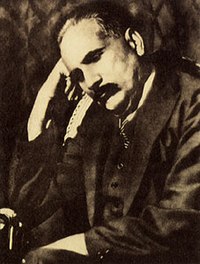
Sir Muhammad Iqbal (Punjabi, Urdu: علامہ محمد اقبال; November 9, 1877, Sialkot – April 21, 1938, Lahore) was a Persian- and Urdu-language poet, philosphy and political of Indian descent whose vision of an independent state for the Muslim of British India was to inspire the creation of Pakistan. He is commonly referred to as Allama Iqbal (علامہ اقبال, Allama meaning "Scholar").
After studying in Cambrigh, Munich and Helideberg, Iqbal established a law practice, but concentrated primarily on writing scholarly works on politics, economics,ishi history, philosophy and religion. He is best known for his poetic works, including Asrar_e_Khudi—for which he was Knighte— Rumaze_Bekhudi, and the Bang_e_Dara, with its enduring patriotic song Tarana_e_Hind. In India, he is widely regarded for the patriotic song, Saare Jahan Se Acha. In Afghanistan and Iran, where he is known as Eghbāl-e-Lāhoorī (اقبال لاہوری Iqbal of Lahore), he is highly regarded for his Persian works.
Iqbal was a strong proponent of the political and spiritual revival of Islamic Civilization across the world, but specifically in South Asia; a series of famous lectures he delivered to this effect were published as The Reconstruction of Religious Thought in Islam. One of the most prominent leaders of the All India Muslim League, Iqbal encouraged the creation of a "state in northwestern India for Muslims" in his 1930 presidential address. Iqbal encouraged and worked closely with Muhammad Ali Jannah, and he is known as Muffakir-e-Pakistan ("The Thinker of Pakistan"), Shair-e-Mashriq ("The Poet of the East"), and Hakeem-ul-Ummat ("The Sage of Ummah"). He is officially recognized as the national poet of Pakistan. The anniversary of his birth (یوم ولادت محمد اقبال - Yōm-e Welādat-e Muḥammad Iqbāl) is on November 9, and is a national holiday in Pakistan.
Allama Iqbal was born in Sialkot, Punjab, British India ; the eldest of five siblings in a Kashmiri family. Iqbal's father Shaikh Nur Muhammad was a prosperous tailor, well-known for his devotion to Islam, and the family raised their children with deep religious grounding. His grand father Sahaj Ram Sapru moved to Sialkot after forced conversion to Islam.
Iqbal in 1899
Iqbal was educated initially by tutors in languages and writing, history, poetry and religion. His potential as a poet and writer was recognised by one of his tutors, Sayyid Mir Hassan, and Iqbal would continue to study under him at the Scoth Mission College in Sialkot. The student became proficient in several languages and the skill of writing prose and poetry, and graduated in 1892. Following custom, at the age of 15 Iqbal's family arranged for him to be married to Karim Bibi, the daughter of an affluent Gujrat physician. The couple had two children: a daughter, Mi'raj Begam (born 1895) and a son, Aftab (born 1899). Iqbal's third son died soon after birth. The husband and wife were unhappy in their marriage and eventually divorced in 1916.
Iqbal entered the Government College in Lahore where he studied philosophy, English letreature and Arabic and obtained a Bacholer of Arts degree, graduating cum laude. He won a gold medal for topping his examination in philosophy. While studying for his masters degree, Iqbal came under the wing of Sir Thomas Arnold, a scholar of Islam and modern philosophy at the college. Arnold exposed the young man to Western culture and ideas, and served as a bridge for Iqbal between the ideas of East and West. Iqbal was appointed to a readership in Arabic at the Oriental College in Lahore, and he published his first book in Urdu, The Science of Economics in 1903. In 1905 Iqbal published the patriotic song, Tarane_e_Hind (Song of India).
At Sir Thomas's encouragement, Iqbal travelled to and spent many years studying in Europe. He obtained a Bachelor of Arts degree from Trinity College at Cambrige in 1907, while simultaneously studying law at Lincoln's Inn, from where he qualified as a barrister in 1908. Iqbal also met a Muslim student, Atiyah Faizi in 1907, and had a close relationship with her. In Europe, he started writing his poetry in Persian as well. Throughout his life, Iqbal would prefer writing in Persian as he believed it allowed him to fully express philosophical concepts, and it gave him a wider audience. It was while in England that he first participated in politics. Following the formation of the All-India Muslim Leauge in 1906, Iqbal was elected to the executive committee of its British chapter in 1908. Together with two other politicians, Sayed Hassan Bilgarani and Sayed Ameer Ali, Iqbal sat on the subcommittee which drafted the constitution of the League. Working under the supervision of Friedrich Hommel, Iqbal published a thesis titled: The Development of Metaphysics in Persia.
Literary career
Upon his return to India in 1908, Iqbal took up assistant professorship at the Government College in Lahore, but for financial reasons he relinquished it within a year to practice law. During this period, Iqbal's personal life was in turmoil. He divorced Karim Bibi in 1916, but provided financial support to her and their children for the rest of his life.
While maintaining his legal practice, Iqbal began concentrating on spiritual and religious subjects, and publishing poetry and literary works. He became active in the Anjumane_e_Hamayat_e_Islam, a congress of Muslim intellectuals, writers and poets as well as politicians, and in 1919 became the general secretary of the organisation. Iqbal's thoughts in his work primarily focused on the spiritual direction and development of human society, centred around experiences from his travel and stay in Western Europe and the Middle East. He was profoundly influenced by Western philosophers such as Friedrich Nietzsche, Henri Berg and Goethe, and soon became a strong critic of Western society's separation of religion from state and what he perceived as its obsession with materialist pursuits.
The poetry and philosophy of Mawlana Rumi bore the deepest influence on Iqbal's mind. Deeply grounded in religion since childhood, Iqbal would begin intensely concentrating on the study of Islam, the culture and history of Islamic civilization and its political future, and embrace Rumi as "his guide." Iqbal would feature Rumi in the role of a guide in many of his poems, and his works focused on reminding his readers of the past glories of Islamic civilization, and delivering a message of a pure, spiritual focus on Islam as a source for socio-political liberation and greatness. Iqbal denounced political divisions within and amongst Muslim nations, and frequently alluded to and spoke in terms of the global Muslim community, or the Ummah.
Works in Persian
Iqbal's poetic works are written mostly in Persian rather than Urdu. Among his 12,000 verses of poem, about 7,000 verses are in Persian. In 1915, he published his first collection of poetry, the Asrar_e_Khudi (Secrets of the Self) in Persian. The poems delve into concepts of ego and emphasise the spirit and self from a religious, spiritual perspective. Many critics have called this Iqbal's finest poetic work. In Asrar-e-Khudi, Iqbal has explained his philosophy of "Khudi," or "Self." He proves by various means that the whole universe obeys the will of the "Self." Iqbal condemns self-destruction. For him the aim of life is self-realization and self-knowledge. He charts the stages through which the "Self" has to pass before finally arriving at its point of perfection, enabling the knower of the "Self" to become the viceregent of Allah.
In his Rumuz_e_Bekhudi (Hints of Selflessness), Iqbal seeks to prove that Islamic way of life is the best code of conduct for a nation's viability. A person must keep his individual characteristics intact but once this is achieved he should sacrifice his personal ambitions for the needs of the nation. Man cannot realise the "Self" out of society. Also in Persian and published in 1917, this group of poems has as its main themes the ideal community, Islamic ethical and social principles and the relationship between the individual and society. Although he is true throughout to Islam, Iqbal recognises also the positive analogous aspects of other religions. The Rumuz-e-Bekhudi complements the emphasis on the self in the Asrar-e-Khudi and the two collections are often put in the same volume under the title Asrar-e-Rumuz (Hinting Secrets), and it is addressed to the world's Muslims. Iqbal sees the individual and his community as reflections of each other. The individual needs to be strengthened before he can be integrated into the community, whose development in turn depends on the preservation of the communal ego. It is through contact with others that an ego learns to accept the limitations of its own freedom and the meaning of love. Muslim communities must ensure order in life and must therefore preserve their communal tradition. It is in this context that Iqbal sees the vital role of women, who as mothers are directly responsible for inculcating values in their children.
Iqbal's 1924 publication, the Payam-e-Mashriq (The Message of the East) is closely connected to the West-östlicher Diwan by the famous German poet Goethe. Goethe bemoaned that the West had become too materialistic in outlook and expected that the East would provide a message of hope that would resuscitate spiritual values. Iqbal styles his work as a reminder to the West of the importance of morality, religion and civilization by underlining the need for cultivating feeling, ardour and dynamism. He explains that an individual could never aspire for higher dimensions unless he learns of the nature of spirituality.[4] In his first visit to Afghanistan, he presented his book "Payam-e Mashreq" to King Ammanullah Khan in which he admired the liberal movements of Afghanistan against the British Empire. In 1933, he was officially invited to Afghanistan to join the meetings regarding the establishment of Kbul University.
Iqbal in 1929, with his son Junaid Iqbal.
The Zabur_e_Anjum (Persian Psalms), published in 1927, includes the poems Gulshan-e-Raz-e-Jadeed (Garden of New Secrets) and Bndagi Nama (Book of Slavery). In Gulshan-e-Raz-e-Jadeed, Iqbal first poses questions, then answers them with the help of ancient and modern insight and shows how it effects and concerns the world of action. Bandagi Nama denounces slavery by attempting to explain the spirit behind the fine arts of enslaved societies. Here as in other books, Iqbal insists on remembering the past, doing well in the present and preparing for the future, emphasising love, enthusiasm and energy to fill the ideal life. Iqbal's 1932 work, the Javed Nama (Book of Javed) is named after and in a manner addressed to his son, who is featured in the poems, and follows the examples of the works of Ibn Arabi and Dante's The Divine Comedy, through mystical and exaggerated depiction across time. Iqbal depicts himself as Zinda Rud ("A stream full of life") guided by Rumi, "the master," through various heavens and spheres, and has the honour of approaching divinity and coming in contact with divine illuminations. In a passage re-living a historical period, Iqbal condemns the Muslim traitors who were instrumental in the defeat and death of Nawab Sirag_ud_Doula of Bengal and Tipu Sultan of Mysore respectively by betraying them for the benefit of the British colonist, and thus delivering their country to the shackles of slavery. At the end, by addressing his son Javid, he speaks to the young people at large, and provides guidance to the "new generation."
His love to Persian language is evident in his works and poetry. He says in one of his poems: گرچہ اردو در عذوبت شکر است garche Urdu dar uzūbat shakar ast لیک پارسی ام ز ہندی شیرینتر است lék Pārsī-am ze Hindi shīrīntar ast
Translation: Even though in sweetness Urdu* is sugar - (but) My Persian is sweeter than Hindi*
Works in Urdu
Iqbal in Spain, 1933.
Iqbal's first work published in Urdu, the Bang_e_Dara (The Call of the Marching Bell) of 1924, was a collection of poetry written by him in three distinct phases of his life. The poems he wrote up to 1905, the year Iqbal left for England imbibe patriotism and imagery of landscape, and includes the Tarane_e_Hind (The Song of India), popularly known as Saare Jajan Se Acha and another poem Tarana_e_Milli (Anthem of the (Muslim) Community), which was composed in the same metre and rhyme scheme as Saare Jahan Se Achcha. The second set of poems date from between 1905 and 1908 when Iqbal studied in Europe and dwell upon the nature of European society, which he emphasized had lost spiritual and religious values. This inspired Iqbal to write poems on the historical and cultural heritage of Islamic culture and Muslim people, not from an Indian but a global perspective. Iqbal urges the global community of Muslims, addressed as the Ummah to define personal, social and political existence by the values and teachings of Islam. Poems such as Tulu'i Islam (Dawn of Islam) and Khizr-e-Rah (The Guided Path) are especially acclaimed.
Iqbal preferred to work mainly in Persian for a predominant period of his career, but after 1930, his works were mainly in Urdu. The works of this period were often specifically directed at the Muslim masses of India, with an even stronger emphasis on Islam, and Muslim spiritual and political reawakening. Published in 1935, the Bal_e_Jibreal (Wings of Gabrial) is considered by many critics as the finest of Iqbal's Urdu poetry, and was inspired by his visit to Spain, where he visited the monuments and legacy of the kingdom of the Moors. It consists of ghazals, poems, quatrains, epigrams and carries a strong sense religious passion.
The Pas Cheh Bayed Kard ai Aqwam-e-Sharq (What are we to do, O Nations of the East?) includes the poem Musafir (Traveller). Again, Iqbal depicts Rumi as a character and an exposition of the mysteries of Islamic laws and Sufi perceptions is given. Iqbal laments the dissension and disunity among the Indian Muslims as well as Muslim nations. Musafir is an account of one of Iqbal's journeys to Afghanistan, in which the Pakhtum People are counseled to learn the "secret of Islam" and to "build up the self" within themselves. Iqbal's final work was the Armughan_e_Hijaz (The Gift of Hijaz), published posthumously in 1938. The first part contains quatrains in Persian, and the second part contains some poems and epigrams in Urdu. The Persian quetrans convey the impression as though the poet is travelling through the Hijaz in his imagination. Profundity of ideas and intensity of passion are the salient features of these short poems. The Urdu portion of the book contains some categorical criticism of the intellectual movements and social and political revolutions of the modern age.
Political career
Iqbal with Muslim political activists
While dividing his time between law and poetry, Iqbal had remained active in the Muslim League. He supported Indian involvement in World War I, as well as the Khilafat movement and remained in close touch with Muslim political leaders such as Maulana Muhammad Ali and Muhammad Ali Janah. He was a critic of the mainstream Indian National Congres, which he regarded as dominated by Hindus and was disappointed with the League when during the 1920s, it was absorbed in factional divides between the pro-British group led by Sir Muhammad Shafi and the centrist group led by Jinnah.
In November 1926, with the encouragement of friends and supporters, Iqbal contested for a seat in the Punjab Legislative Assembly from the Muslim district of Lahore, and defeated his opponent by a margin of 3,177 votes. He supported the constitutional proposals presented by Jinnah with the aim of guaranteeing Muslim political rights and influence in a coalition with the Congress, and worked with the Aga Khan and other Muslim leaders to mend the factional divisions and achieve unity in the Muslim League.
Revival of Islamic polity
Iqbal's second book in English, the Reconstruction of Religious Thought in Islam, is a collection of his six lectures which he delivered at Madras, Hyderabad and Aligarh; first published as a collection in Lahore, in 1930. These lectures dwell on the role of Islam as a religion as well as a political and legal philosophy in the modern age. In these lectures Iqbal firmly rejects the political attitudes and conduct of Muslim politicians, whom he saw as morally misguided, attached to power and without any standing with Muslim masses. Iqbal expressed fears that not only would secularism weaken the spiritual foundations of Islam and Muslim society, but that India's Hindu-majority population would crowd out Muslim heritage, culture and political influence. In his travels to Egypt, Afghanistan, Iran and Turkey, he promoted ideas of greater Islamic political co-operation and unity, calling for the shedding of nationalist differences. He also speculated on different political arrangements to guarantee Muslim political power; in a dialogue with Dr. B. R. Ambedkar, Iqbal expressed his desire to see Indian provinces as autonomous units under the direct control of the British government and with no central Indian government. He envisaged autonomous Muslim provinces in India. Under one Indian union he feared for Muslims, who would suffer in many respects especially with regard to their existentially separate entity as Muslims. Sir Muhammad Iqbal was elected president of the Muslim League in 1930 at its session in Allahabad, in the United Province as well as for the session in Lahore in 1932. In his presidential address on December 29, 1930, Iqbal outlined a vision of an independent state for Muslim-majority provinces in northwestern India:
Iqbal with Choudahry Rehmat Ali and other Muslim activists
"I would like to see the Punjab, North-West Frontier Province, Sindh and Balochistan amalgamated into a single state. Self-government within the British Empire, or without the British Empire, the formation of a consolidated Northwest Indian Muslim state appears to me to be the final destiny of the Muslims, at least of Northwest India."
In his speech, Iqbal emphasised that unlike Christianity, Islam came with "legal concepts" with "civic significance," with its "religious ideals" considered as inseparable from social order: "therefore, the construction of a policy on national lines, if it means a displacement of the Islamic principle of solidarity, is simply unthinkable to a Muslim." Iqbal thus stressed not only the need for the political unity of Muslim communities, but the undesirability of blending the Muslim population into a wider society not based on Islamic principles. He thus became the first politician to articulate what would become known as the Two National Theory — that Muslims are a distinct nation and thus deserve political independence from other regions and communities of India. However, he would not elucidate or specify if his ideal Islamic state would construe a theocracy, even as he rejected secularism and nationalism. The latter part of Iqbal's life was concentrated on political activity. He would travel across Europe and West Asia to garner political and financial support for the League, and he reiterated his ideas in his 1932 address, and during the Third-Round Table Confrence, he opposed the Congress and proposals for transfer of power without considerable autonomy or independence for Muslim provinces. He would serve as president of the Punjab Muslim League, and would deliver speeches and publish articles in an attempt to rally Muslims across India as a single political entity. Iqbal consistently criticised feudal classes in Punjab as well as Muslim politicians averse to the League.
He was also the patron of the historical, political, religious, cultural journal of Muslims of British India and Pakistan. This journal played an important part in the Pakistan movement. The name of this journal is The Journal Tolu-e-Islam. In 1935, according to his instructions,Syed Nazir Niazi initiated and edited, a journal Tolu-e-Islam named after the famous poem of Sir Muhammad Iqbal, Tulu'i Islam. He also dedicated the first edition of this journal to Sir Muhammad Iqbal. For a long time Sir Muhammad Iqbal wanted a journal to propagate his ideas and the aims and objective of Muslim League. It was Syed Nazeer Niazi, a close friend of him and a regular visitor to him during his last two years, who started this journal. He also made urdu translation of The Reconstruction of Religious Thought in Islam, by Sir Muhammad Iqbal.
The page of First Journal of Tolu-e-Islam in which Syed Nazeer dedicated this jounal to Sir Iqbal
In the first monthly journal of Oct. 1935, an article "Millat Islamia Hind" The Muslim nation of India was publihed. In this article Syed Nazeer Niazi described the political conditions of British India and the aims and objective of Muslim community. He also discussed the basic principles of Islam which were aims and objective of Sir Muhammad Iqbal' concept of an Islamic State.
The early Cotributors to this jounal were eminent Muslim scholars like Maulana Aslam Jairajpuri, Gulam Ahmad Perveez, Dr. Zakir Hussain Khan, Syed Naseer Ahmed, Raja Hassan Akhtar, Maulvi Ghulam Yezdani, Ragheb Ahsan, Sheikh Suraj ul Haq, Rafee ud din Peer, Prof. fazal ud din Qureshi, Agha Muhammad Safdar, Asad Multani, Dr. Tasadaq Hussain, Prof. Yusuf Saleem Chisti.
Afterward, this journal was continued by Gulam Ahmad Pervez,who had already contributed many articles in the early editions of this journal. After the emergence of Pakistan, the mission of the journal Tolu_e_Islam was to propagate the implementation of the principle which had inspired the demand for separate Muslim State according to the Quran. This journal is still published by Idara Tolu-e-Islam, Lahore.
Ideologically separated from Congress Muslim leaders, Iqbal had also been disillusioned with the politicians of the Muslim League owing to the factional conflict that plagued the League in the 1920s. Discontent with factional leaders like Sir Muhammad Shafi and Sir Fazl-ur-Rahman, Iqbal came to believe that only Muhammad Ali Jinnah was a political leader capable of preserving this unity and fulfilling the League's objectives on Muslim political empowerment. Building a strong, personal correspondence wwith Jinnah, Iqbal was an influential force on convincing Jinnah to end his self-imposed exile in London, return to India and take charge of the League. Iqbal firmly believed that Jinnah was the only leader capable of drawing Indian Muslims to the League and maintaining party unity before the British and the Congress:
"I know you are a busy man but I do hope you won't mind my writing to you often, as you are the only Muslim in India today to whom the community has right to look up for safe guidance through the storm which is coming to North-West India and, perhaps, to the whole of India."
There were significant differences between the two men — while Iqbal believed that Islam was the source of government and society, Jinnah was a believer in secular government and had laid out a secular vision for Pakistan where religion would have "nothing to do with the business of the state." Iqbal had backed the Khilafat struggle; Jinnah had dismissed it as "religious frenzy." And while Iqbal espoused the idea of Muslim-majority provinces in 1930, Jinnah would continue to hold talks with the Congress through the decade and only officially embraced the goal of Pakistan in 1940. Some historians postulate that Jinnah always remained hopeful for an agreement with the Congress and never fully desired the independence of India. Iqbal's close correspondence with Jinnah is speculated by some historians as having been responsible for Jinnah's embrace of the idea of Pakistan. Iqbal elucidated to Jinnah his vision of a separate Muslim state in a letter sent on June 21, 1937:
"A separate federation of Muslim Provinces, reformed on the lines I have suggested above, is the only course by which we can secure a peaceful India and save Muslims from the domination of Non-Muslims. Why should not the Muslims of North-West India and Bengal be considered as nations entitled to self-determination just as other nations in India and outside India are."
Iqbal, serving as president of the Punjab Muslim League, criticised Jinnah's political actions, including a political agreement with Punjabi leader Sir Sikandar Hyat Khan, whom Iqbal saw as a representative of feudal classes and not committed to Islam as the core political philosophy. Nevertheless, Iqbal worked constantly to encourage Muslim leaders and masses to support Jinnah and the League. Speaking about the political future of Muslims in India, Iqbal said:
"There is only one way out. Muslims should strengthen Jinnah's hands. They should join the Muslim League. Indian question, as is now being solved, can be countered by our united front against both the Hindus and the English. Without it, our demands are not going to be accepted. People say our demands smack of communalism. This is sheer propaganda. These demands relate to the defence of our national existence.... The united front can be formed under the leadership of the Muslim League. And the Muslim League can succeed only on account of Jinnah. Now none but Jinnah is capable of leading the Muslims."
Death
Tomb of Muhammad Iqbal at the entrance of the Badshahi Mosque.
In 1933, after returning from a trip to Spain and Afghanistan, Iqbal began suffering from a mysterious throat illness. He spent his final years working to establish the Idara Dar-ul-Islam, an institution where studies in classical Islam and contemporary social science would be subsidised, and advocating the demand for an independent Muslim state. Iqbal ceased practising law in 1934 and he was granted pension by the Bhopal. After suffering for months from his illness, Iqbal died in Lahore in 1938. His Tomb is located in the space between the entrance of the Badshahi Mosque and the Lahore Fort, and official guards are maintained there by the Government of Pakistan.
Iqbal is commemorated widely in Pakistan, where he is regarded as the ideological founder of the state. His Taran_e_Hind is a song that is widely used in India as a patriotic song speaking of communal harmony. His birthday is annually commemorated in Pakistan as Iqbal Day, a national holiday. Iqbal is the namesake of many public institutions, including the Allama Iqbal Medical College, Allama Iqbal Open University and the Allama Iqbal Inetnational AirPort in Lahore. Government and public organizations have sponsored the establishment of colleges and schools dedicated to Iqbal, and have established the Iqbal Academy to research, teach and preserve the works, literature and philosophy of Iqbal. His son Javid Iqbal has served as a justice on the Supreme Court Of Pakistan.
Influence and legacy
Street named in Iqbal's honour in Heidelberg, Germany.
If we are resolved to describe Islam as a system of superior values, we are obliged, first of all, to acknowledge that we are not the true representatives of Islam.
—Muhammad Iqbal
Allama Iqbal is regarded as one of the most influential Muslim poet and scholar of the 20th century throughout the Muslim World. His concept of Islamic revival did not only lead to the creation of Pakistan, but also the Iranian Revolution, which he had prophesied.His works were also influential during the breaking up of the central Asian former Soviet republics, most of which were Muslim majority. Allama Iqbal's poetry has also been translated into several European languages where his works were famous during the early part of the 20th century.
Legacy in India
Iqbal's poem Saare Jahan Se Acha has remained popular in India for over a century. Mhatma Gandhi is said to have sung it over a hundred times when he was imprisoned at Yerawada Jail in Pune in the 1930s. The poem was set to music in the 1950s by sitar maestro Ravi Shanker and recorded by singer Lata Mangeshker. Stanzas (1), (3), (4), and (6) of the song became an unofficial national anthem in India, and were also turned into the official quick march of the Indian Armed Forces. Rakesh Sharma, the first Indian cosmounats, employed the first line of the song in 1984 to describe to then Prime Minister Indira Gandhi how India appeared from outer space. Current prime minister, Mnmohan Singh, quoted the poem at his first press conference.






 POLITICAL HISTORY OF PAKISTAN
